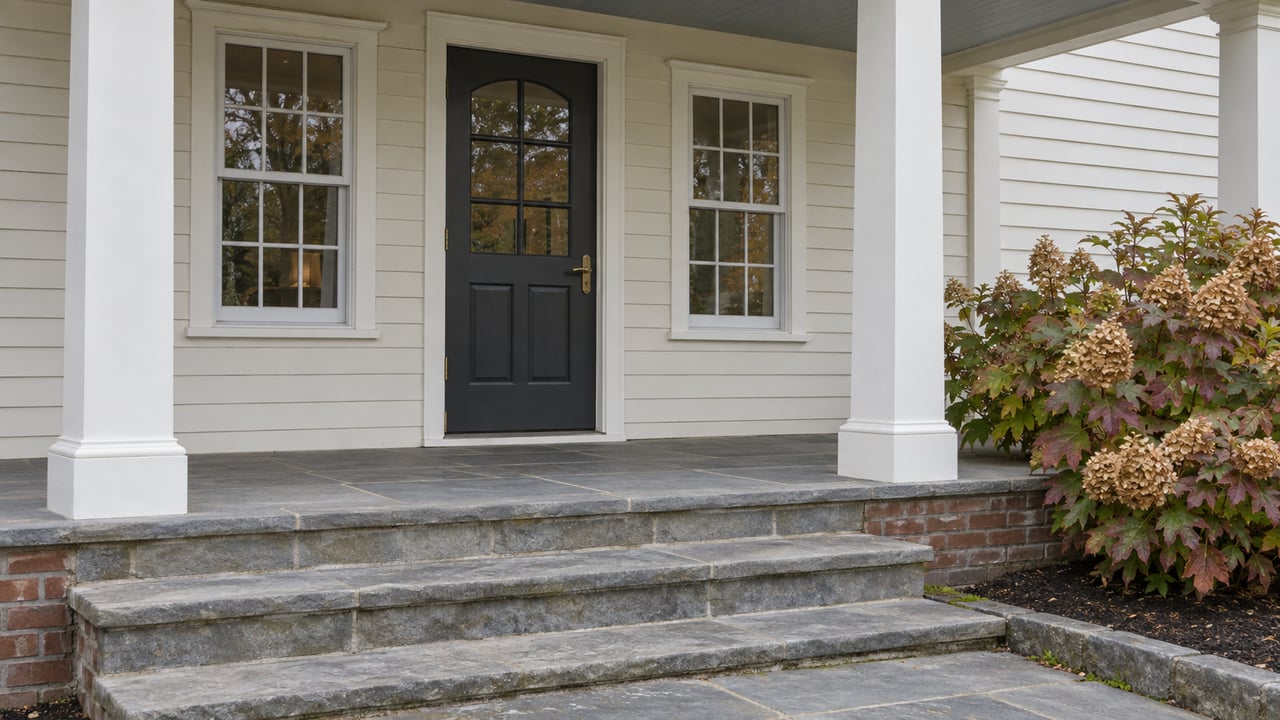
Two houses, half a mile apart in Simsbury, can be on completely different infrastructure. One might be tied into public water and sewer systems. The other, despite looking just as finished and just as move-in ready, might be running entirely on a private well and a septic tank buried somewhere in the side yard. The utility setup is another important detail to confirm, alongside square footage, year built and finishes.
That gap matters more in Simsbury than in most Farmington Valley towns, because the parts of Simsbury with the biggest lots and the highest price tags are also the parts most likely to be off the public grid entirely.
The town draws the line, not the map
Simsbury's own government makes this explicit. The town's public FAQ page states plainly that public water is not serviced by the Town itself. Where public water exists, it comes from Aquarion Water Company's Simsbury System, a utility that has operated in the area since 1857 and currently serves roughly 14,691 residents, drawing its supply from wells that pump the Surficial Aquifer beneath its service area.
Everyone else is on a private well. And private wells are not the town's business at all. As the town's FAQ puts it, "public water is not serviced by the Town," and anything running on a private well falls instead under the Farmington Valley Health District, the regional agency that handles well questions for Simsbury and its neighboring Farmington Valley towns. Septic systems get the same treatment. Simsbury's own FAQ confirms that not every property is connected to the public sewer system, and that septic systems are serviced by private companies rather than the town, again under Farmington Valley Health District oversight.
Service boundaries follow specific streets, not neighborhood reputations or elevation. Aquarion's own maintenance notices, for instance, list streets such as West Mountain Road among the addresses inside its Simsbury service area, a reminder that a house on one side of a ridge can sit on the public system while a house a quarter mile away runs on a private well. Confirming whether a specific address sits inside that public service area or outside it is a five-minute check on the state's Public Water Supply Map before you ever write an offer. Most buyers skip it because it's easy to assume that a neighborhood's general reputation, mountain-adjacent and rural on one side, walkable and villagey on the other, tells you which utility system a given house is on. It doesn't.
The premium and the plumbing tend to travel together
Here is where the pattern gets interesting for anyone shopping Simsbury on price. Zillow's home value index put the average West Simsbury home at $614,405 as of its May 31, 2026 update, up 5.1% over the past year. The townwide average sits noticeably lower: $556,416 as of the June 30, 2026 update, up 6.1% year over year. West Simsbury isn't just a little pricier than Simsbury as a whole. It sits in a distinct, higher tier.
Redfin's sale-by-sale data for West Simsbury's own zip code adds a rougher texture to that same story. Over the three months ending May 2026, the median sale price there was $692,000, actually down 4.6% from the same period a year earlier, even as price per square foot climbed 13.3% to $250. Only 4 homes sold in that window, compared with 15 the year before, and the typical listing took 18 days to sell instead of 7. A pocket that thin can look like it's overheating or cooling almost entirely based on which handful of houses happen to close in a given month.
That volatility is itself a clue. In Connecticut towns like Simsbury, the properties furthest from a village center, on larger lots, closer to hillside terrain, tend to be the ones most likely to sit outside a water utility's mapped service area and rely on a private well and septic system instead. West Simsbury's larger lots and higher price points make that pattern reasonable to expect more often there than in the village core. Reasonable to expect is not the same as confirmed, though, and the only way to know for a specific house is to check the address, not the neighborhood's reputation.
The price premium in West Simsbury reflects real value: more land, more privacy, mountain-adjacent views. Part of what that premium often buys, though, is a private water and waste system that a buyer closer to Simsbury Center may never have to think about, and that system comes with its own due-diligence calendar.
What "off the grid" actually requires before closing
A private well and septic system are not automatically a problem. Thousands of Connecticut households run on them without incident. But they carry their own due-diligence checklist, one that a public-water buyer never has to schedule, and it needs to happen inside the contingency period, not after.
- A flow rate test on the well. This measures how many gallons per minute the well can actually produce. Many home inspectors treat a flow rate below roughly 3 gallons per minute as the threshold for calling in a well specialist, since anything below that can strain a household's daily water use.
- A water quality panel, separate from the flow test. Connecticut guidance calls for testing at minimum for total coliform bacteria, E. coli, nitrates, pH, and hardness. Depending on the property's history and location, buyers may also want to test for arsenic, radon, or volatile organic compounds.
- A septic inspection and pump-out, which checks the tank's structural condition, measures sludge and scum levels, and can include a dye test to confirm the leach field is absorbing effluent the way it should.
- A records check. Ask for the septic system's age, its "as-built" diagram if one exists, and when it was last pumped. Older tanks and cesspools sometimes need full replacement, and that work runs somewhere between $3,000 and $10,000 depending on tank size and site conditions.
This is the difference between inheriting a system you understand and inheriting one you're guessing about, and many lenders will require at least a flow test as a loan condition even if the buyer doesn't ask for one.
Why the calendar matters more than the checklist
None of this diligence is complicated on its own. What makes it tricky in Simsbury right now is timing. Zillow's June 2026 data shows Simsbury homes going to pending in around 4 days. Movoto's May 2026 figures put median days on market at 9, down 18% from the prior year. That is not a market where a buyer has two weeks to casually schedule a well company and wait on lab results.
A standard home inspection contingency, the kind written for a house on public water and sewer, often does not build in enough runway for a flow test, a multi-day water panel turnaround, and a full septic pump-out and inspection. Buyers who don't ask the utility question on day one of touring a home are often the ones who end up either waiving a well and septic contingency they didn't realize they needed, or losing the house to another offer while they scramble to schedule tests after the fact.
The fix is simple and it costs nothing: ask whether a property is on public water and sewer or on a private well and septic before you tour it, not after you've fallen for it. If it's the latter, build the flow test, water panel, and septic inspection into your offer's contingency period from the start, with a timeline that actually matches how fast these tests can be scheduled locally.
A few questions worth asking early
Does every well in Simsbury need the full water panel, or just a flow test? Both matter, and they test different things. A flow test only tells you how much water the well produces. It says nothing about what's in that water. Connecticut's minimum recommended panel, coliform, E. coli, nitrates, pH, and hardness, is a separate process and worth doing on every private well regardless of how the flow test comes back.
Is a septic system a red flag on its own? No. A well-maintained septic system with clean pump-out records and a documented "as-built" diagram is often no more of a concern than an aging boiler. The key concerns are missing system records and a system old enough that replacement, not repair, becomes the realistic outcome.
How do I even find out if an address is on public water? The state maintains a Public Water Supply Map that shows service area boundaries, and it takes just a few minutes to check an address before you tour. Confirming service area status through the town's own Water Pollution Control Facility is worth the extra call if the map leaves any ambiguity for a specific parcel.
Simsbury's appeal is not up for debate. The valley, the river access, the mountain views from the western side of town, all of it is real. But a buyer who understands which side of the water line a home sits on before they write an offer is a buyer who negotiates from a position of knowledge instead of catching up after the fact.
If you're weighing a Simsbury purchase and want someone who can walk the utility question through with you property by property, the Marshall & Ostop Team works this market from the valley floor to the mountain roads every week. Schedule a complimentary home consultation and we'll help you sort out exactly what a specific address does and doesn't come with before you fall for the view.
This article is general information, not legal, tax or financial advice. Consult a qualified professional about your situation.